

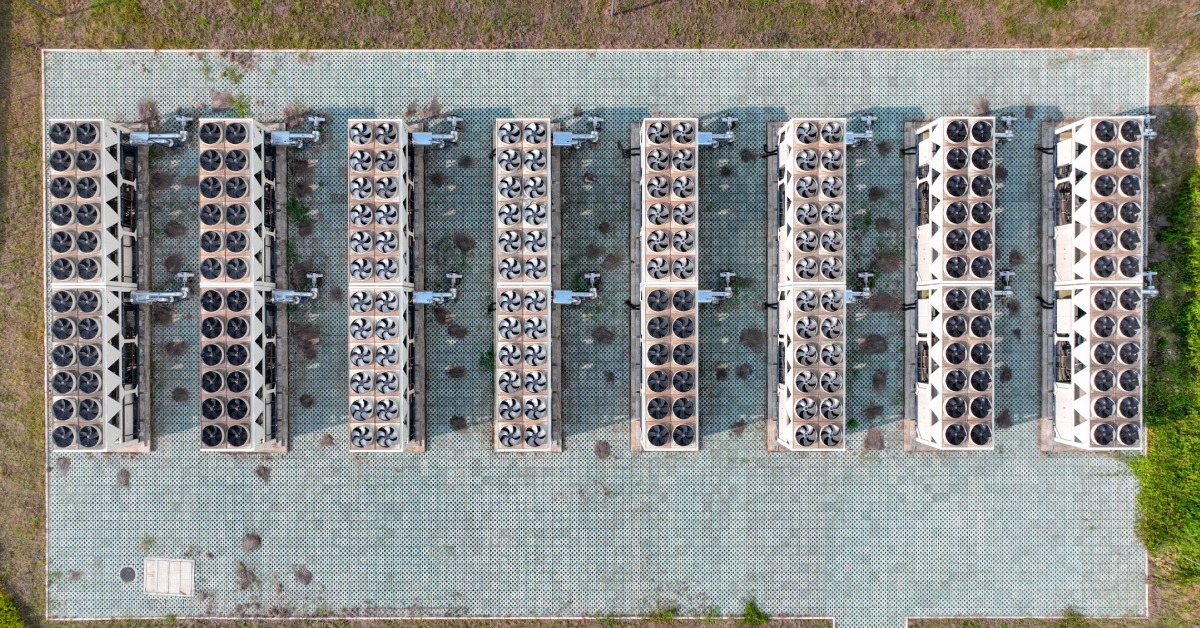
District cooling, however, adopts a different logic: chilled water is uniformly produced at a central energy station and delivered to various buildings through a network of underground pipes to create a cooling effect.
The operating concept of district cooling is similar to that of tap water, city gas, and electricity systems, and is considered one of the essential infrastructures of modern cities.
[…]
Compared to traditional decentralised, the advantages of district cooling are clear: it reduces energy consumption, lowers noise and heat emissions from cooling towers, and can also balance peak electricity demand through centralised dispatch, making it a relatively new low-carbon functional approach.
[…]
The environmental benefits are also considerable. After the project is fully operational, it is estimated to save 7,374 tonnes of standard coal and reduce carbon dioxide emissions by about 18,000 tonnes annually; compared to traditional central air conditioning, the comprehensive energy-saving rate exceeds 30%.
[…]
The system also uses AI algorithms, combined with weather forecasts, historical data, and cooling usage patterns, to predict the next day’s cooling demand; it then stores cooling capacity during the night when electricity prices are lower, and dispatches it according to demand during the day.
The interconnected pipe network between multiple cooling stations also allows for mutual support when individual stations are under high load.
All of this is extremely cool (pun intended), and i am firmly convinced that, just like district heating (which, by the way, the Soviet Union was a huge adopter of and was already implementing in the 1930s, eventually building the largest centralized heating network in the world), this is ultimately the future of urban infrastructure.
It is the inevitable next logical step to switch from individual to collective temperature regulation systems for energy efficiency purposes.
I am just wondering about the exact implementation. With heating you can run the warm water pipes through the floor or into radiators in the rooms, but with cold water this is a little more complicated.
The principle is not complicated: in winter, hot water flows through the pipes to heat the houses, and in summer, the pipes are switched to chilled water to cool the houses.
Is it really that simple? For one thing you probably don’t want to have the cooling happening through the floor, right? Unlike heated floors which are quite nice i imagine that having really cold floors would get uncomfortable in a living space.
Also, what do you do with the condensation? Especially in high humidity environments, whenever you cool warm air with a cold surface you will get condensation. That needs to be dealt with somehow in order not to lead to mold.
That is one advantage of air conditioning, which is that it reduces humidity, which can be very much necessary depending on where you live.
So i imagine the best solution would be to do what air conditioning units do anyway: run air over the cool pipes in an enclosed space that can gather and expel the moisture, and then pipe that cool air into the homes, no? But if so then i am a bit confused by this statement in the article:
Its cooling core is not about “creating cold air”, but about removing heat from indoors.
How do you remove heat without creating cold air? I would have liked if the article explained that part a bit more.
https://www.sciencedirect.com/science/article/pii/S2666519026001561
If you search condensation / condensation management in the pdf you will be able to jump through it quicker.
I have read elsewhere: run the pipes through the ceiling and condensate trays to collect excess vapour. The more sophisticated way apparently is to control water temperature and flow adjusting for a potential dew point; the latter is what the paper focuses on. I’m guessing implementation of AI here will make a signficant difference in management.
Cooling the ceiling makes the most sense. The inverse of heating the floor where you allow heat to rise, this way you let the cool air fall down. Thanks for that link, it looks like an interesting read.
This is super interesting, thanks!
When I was in HK and Malaysia over the winder, I noticed how AC was blasted everywhere indoors, especially in public places. It got me curious and that’s how I learned about AC being used to dry out the air to combat mold.
And with removing heat wording I think they just mean that instead of blasting cold air actively through the space as you do with AC, instead they just use cold surfaces to passively cool the environment.
Since hot air rises, im wondering about floor cooling, too, which means in multistory buildings, those middle units would have the most cooling. As for humidity, I would imagine dehumidifiers, even homemade or maybe blankets with some sort of desiccants for walls, which would offer sound proofing? I don’t even know if that’s a thing, but I’d love some.
I heard about a man who installed floor cooling in his business. It did not go well. Water condensed on the floors.
I can imagine it didn’t go well!
incidentally, sound proofing is the reason why putting carpets on walls was a popular thing in the Soviet bloc
Hah! I never considered that, I thought as warmth/insulation.
This exists elsewhere and has for decades. I’m not trying to take away from what accomplishments are described in the article, only to say there is a lot of info available. The one I am most familiar with is in Toronto, the Deep Lake Water Cooling System.
Is it really that simple? For one thing you probably don’t want to have the cooling happening through the floor, right? Unlike heated floors which are quite nice i imagine that having really cold floors would get uncomfortable in a living space.
I worked in an industrial facility that used this style of system (switch from hot water to cold water). It was built in the late 1950s. It wasn’t centralized, but had the same end of loop systems. It used radiators.
Also, what do you do with the condensation? Especially in high humidity environments, whenever you cool warm air with a cold surface you will get condensation. That needs to be dealt with somehow in order not to lead to mold.
There is a fan in the radiator cabinet. I think there is a condensate trap too, but don’t quote me on that.
That is one advantage of air conditioning, which is that it reduces humidity, which can be very much necessary depending on where you live.
I believe the building also had a dehumidifier. Large buildings where this tech is used (currently) have quite complex air handling systems. Switching from a system that cools the air directly (compressors) vs one that uses radiators and cold water does involve some plumbing, but perhaps the air handling unit with the air conditioners can be retrofit with a dehumidifier, so the air is still cycled through that step.
How do you remove heat without creating cold air? I would have liked if the article explained that part a bit more.
I think this statement is getting at two things: you can cool a space without creating cold air (so getting people used to a change in the way cooling is handled) and but also maybe indirectly getting at efficiency.
In a traditional air conditioner you are creating cold air in a central unit. This air is colder than your target temp. This air then circulates and the heat transfer that does the cooling occurs in the air space of the building. The hot air transfers heat to the cold air and maybe if it’s a well designed system displaces the hot air to be returned to the air con.
When your central unit is a water chiller and not an air chiller the initial chilling is more efficient (heat transfer in liquids is more efficient than heat transfer in gas). You also don’t have to cool it as much, because the amount of heat that needs to be removed (transferred from the air to the liquid) is less.
I think I touched on all your questions, but please let me know if you have more or want me to elaborate.
Great answers, thank you! Seems like either way there will be some retrofitting needed in older buildings. You can’t just use the heating system as is and simply switch the warm water out for cold.
As someone in training in this field (heating and cooling) maybe I can add a few things.
In theory running cold water through in-floor tubing works the same as hot water, but many systems must be put in place to make this possible. The most important two are dew point sensors to prevent condensation (in practice this limits the cool water to a maximum difference of 2°C below room temperature) and room temperature controllers which work in both directions. A typical in floor heating system opens a valve when the measured room temperature is below the user set temperature; a cooling system must operate in reverse. This also works with radiators (just not as efficiently due to the smaller surface area), either with dew point sensors or something to catch the condensed water.
Cooling (or heating) the ceiling is a perfectly reasonable alternative, although only starting to become a thing in residential buildings. Wall heating is also an option but gets tricky when people want to mount things to the walls.
I think cooling the building structure makes a lot of sense though. I notice this a lot with traditional central/western European homes. The building is made of very heavy brick or even concrete, which can store a lot of thermal energy. That means the first few hot days of the year don’t really bother people, the building itself is cool so as long as you don’t open the windows the room temperature is also comfortable. But once the building is warm, you’re not going to get it cooled without a longer stretch of cooler outside temperatures. Even if the water temperature in the cooling system is only a degree or two below ambient, that energy removed over days and weeks can make a significant improvement in the comfort felt by occupants.
During the heat waves in Germany this summer what really got to me was that it didn’t cool off overnight, which meant the apartment and building couldn’t cool off. With a cooling system I would have been able to remove at least some of that energy to feel some relief. Even once we got a mobile AC unit, it only helped while running. Less than half an hour after turning it off the room would already return to it’s previous temperature.
Interesting read! (It’s another score for efficiency of collectivisation/centralisation as an approach)


