

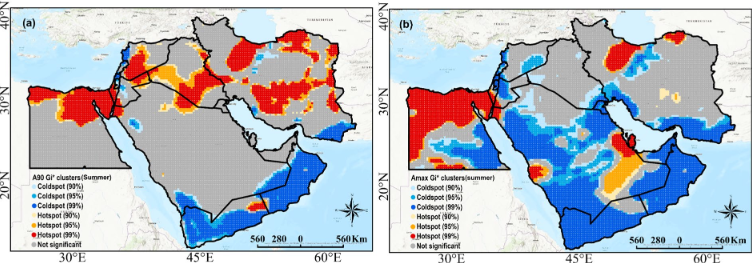
Fig. 5 Spatial clustering of day–night asymmetry in projected temperature extremes during summer (JJA) under SSP5-8.5 for 2075–2100. Panels show Getis–Ord Gi* clusters for (a) A90 and (b) Amax.
A central implication of the analysis is that future heat change should not be interpreted only through regional mean warming or through direct numerical comparison among indices with different units. Percentile-based and intensity-based indices represent different dimensions of heat extremes: TX90p and TN90p describe changes in the frequency of exceedance above fixed historical warm thresholds, whereas TXx and TNx describe changes in the intensity of the hottest daytime and nighttime events. Similarly, the negative regional mean values of A90 and Amax indicate a general tendency toward daytime-dominated amplification, but this response is not spatially uniform. Localized nighttime-dominated areas remain important, particularly where insufficient nighttime cooling may increase cumulative heat burden.
These findings have implications for climate-risk assessment and adaptation planning. Spatially coherent hotspot regions may face increasing pressure on energy systems, outdoor labor, infrastructure, public-health preparedness, and ecosystem resilience. At the same time, localized nighttime amplification may be relevant for heat-health risks because warm nights can reduce physiological recovery from daytime heat exposure, especially in coastal or relatively humid environments. However, this study does not directly quantify population exposure, vulnerability, mortality, humidity-related heat stress, or sector specific impacts.